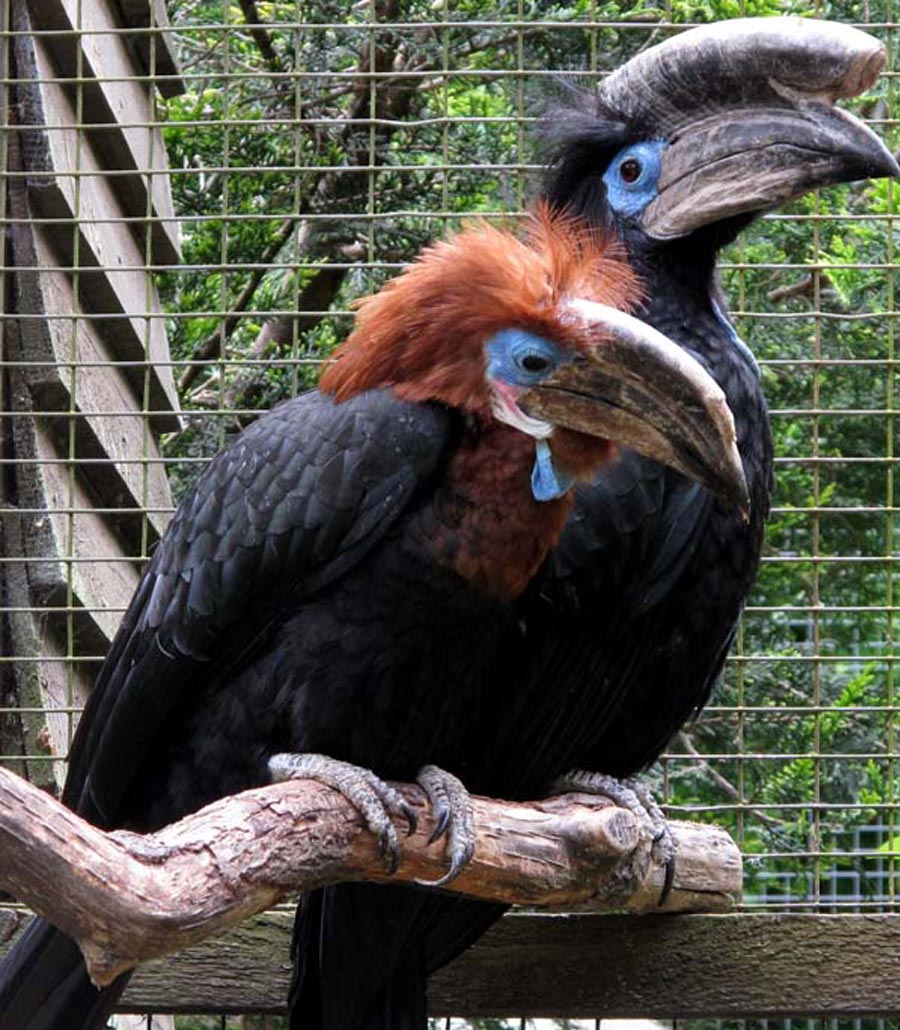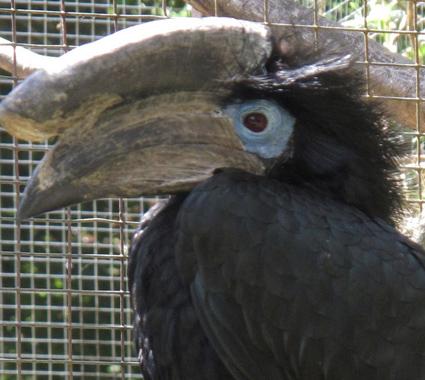
Black-casqued Wattled Hornbill
Scientific Name: Ceratogymna atrata
Fast Facts
- Natural Habitat: Lowland primary rainforests of West and Central Africa
- Distribution: Guinea, Sierra Leone, Gulf of Guinea, Liberia, Cote d’Ivoire, Ghana, Cameroon, Congo Basin (DRC and Central African Republic), Western Uganda, North-western Angola and Bioko Island (part of Equatorial Guinea)
- Lifespan: Up to 19 years
- Diet: Mostly fruit (figs and oil-palm fruits are the most common). Often eat insects, small reptiles, small mammals, eggs from other birds of nestlings. It also eats large seeds.
- Weight: Males: 1 kg-1.6 kg; Females: 0.9 kg-1.2 kg
Behaviour
Black-casqued hornbills typically live together in pairs or small groups, however flocks of up to 40 individuals have been seen. The Black-casqued Hornbill is an important seed disperser because it eats large seeds. After passing through their digestive tract or defecating or dropping fruit, the seeds are spread throughout the forest and help with regeneration.
Reproduction
They appear to be monogamous, breeding once every 1–2 years and the female will lay up to 2 eggs. The pair will nest in an empty tree cavity. Once the female has laid, she will be sealed inside the cavity leaving only a small opening through which the male delivers food.
Conservation Status
Near Threatened (NT)
Threats
Habitat loss such as deforestation due to logging, agricultural expansion and human settlement. Poaching for the wildlife trade is another concern for this species. Climate change can affect the ability of the black-casqued hornbill to find reliable food sources.
Conservation
The primary methods of conservation for this species include the protection of primary forest habitats, maintaining wildlife corridors to allow the hornbill to move between forest patches and continued monitoring. Local community involvement and environmental education are important for ensuring forest land is used sustainably.
Did You Know?
- In 2007, Paultons Park became the first collection in the UK to breed this species successfully, and only the second collection in the world to do so.